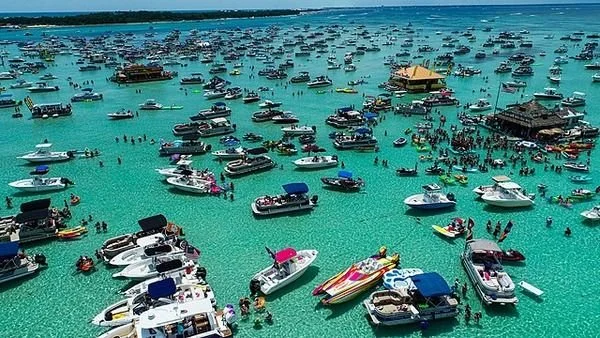
Crab Island is one of the most popular boating spots in Destin, Florida. Clear water, shallow sandbar areas, music, boats everywhere, and a full day hanging out on the water. It is one of the reasons people buy boats, rent boats, and come to Destin in the first place.
But Crab Island is also one of those places that looks easier than it really is.
From a distance, it looks like everyone just pulls up, drops anchor, and has a good time. In reality, you are dealing with current, wind, boat traffic, swimmers, anchor lines, changing tide, and a lot of people who may or may not know what they are doing.
If you are taking your own boat to Crab Island, especially for the first time, there are a few things you need to understand before you go.
What Should You Bring to Crab Island?
Most people search for what to bring to Crab Island because they are thinking about the fun stuff. Drinks, snacks, floats, sunscreen, music, and towels all matter.
But the most important things are the items that keep your boat day from turning into a problem.
At a minimum, you should bring:
Life jackets for everyone on board
Plenty of drinking water
Sunscreen
Towels
A good anchor
Enough anchor line
A charged phone
A dry bag
Trash bags
Snacks or lunch
Basic first aid items
A way to keep phones and valuables dry
A plan for where you want to anchor
A plan for how you are going to leave
That last part matters more than people think.
Most boaters plan for getting to Crab Island. Not enough people think about leaving Crab Island. Pulling anchor, getting people back on the boat, dealing with traffic, watching swimmers, and getting back through Destin Harbor or the East Pass area can be just as important as getting there.
Crab Island Current Is Stronger Than It Looks
Crab Island sits near the Destin East Pass, and the current in that area can be much stronger than people expect.
That is where a lot of new boaters get surprised.
You may feel fine while you are running across open water, but once you slow down and start trying to anchor, the boat becomes much more affected by current and wind. At slow speed, the boat does not respond the same way it does when you are cruising.
The current can start pushing you toward other boats before you even realize how fast you are moving.
Before you get into the crowd, take a minute and watch what the water is doing. Look at how the anchored boats are sitting. Look at which direction their anchor lines are pulling. Watch how fast other boats are drifting when they are not under power.
That will tell you a lot.
If you are not sure what the current is doing, do not rush into the middle of the pack. Stay outside the tighter areas until you have a better feel for it.
For more on how weather, wind, and current affect boat handling, read my article on How Weather Affects Your Boat and What to Watch Before You Leave the Dock.
Anchoring Is Where Most Problems Start
Anchoring at Crab Island sounds simple. Drop the anchor, let out some line, and relax.
That is the idea. But it does not always work that way.
A common mistake is dropping the anchor almost straight down and not letting out enough line. The anchor may hit the bottom, but that does not mean it is set. If you do not have enough line out, the anchor may not dig in properly, especially when current and boat traffic start moving things around.
That is when boats start dragging.
Dragging anchor at Crab Island can get stressful fast. You may drift into another boat, swing sideways, or have to restart the whole process while other boats are watching and the current is still pushing you.
The better move is to take your time.
Approach slowly. Pick your spot before you get too close. Drop the anchor with room to drift back. Let out enough line. Back down gently to help the anchor set. Then watch your position for a few minutes before assuming you are good.
Do not let everyone jump in the water until you know the boat is holding.
That one step can save you a lot of headache.
Give Yourself More Room Than You Think You Need
Crab Island can get packed, especially on weekends, holidays, and pretty summer days.
The temptation is to squeeze into the best-looking spot. That is usually where newer boaters get in trouble.
You need room for your boat to swing. You need room for the current to move you. You need room to correct if something does not go right. You also need room between your boat, other boats, anchor lines, swimmers, and floats.
Your boat is not parked just because the anchor is down.
It is still moving. Maybe not a lot, but it is moving. Wind, current, wake, and anchor angle all affect how your boat sits.
If you are newer or not fully comfortable, do not try to be right in the tightest part of the crowd. Anchor farther out, get settled, and enjoy the day without putting yourself in a bad position.
Nobody is going to care if you are a little farther from the busiest area. They will care if you drag anchor into their boat.
Wind and Current Can Fight Each Other
One of the tricky things about Crab Island is that wind and current do not always work together.
Sometimes the current pulls the boat one way and the wind pushes the boat another way. That can make the boat sit sideways, swing differently than expected, or feel like it is not responding the way it should.
This is where people overcorrect.
They give it too much throttle. They turn too hard. They get nervous because the boat is not moving how they expected. Then the situation gets worse.
Slow-speed boat handling is all about staying calm and making small corrections. The more you rush, the easier it is to lose control.
This is the same reason docking gets difficult in wind. A boat does not always move like a car. It slides, pivots, drifts, and reacts differently depending on the hull, windage, current, and prop setup.
If docking in wind is something you are still working on, read How to Dock a Boat in Wind: Real Tips That Work in Destin.
Watch Out for Other Boaters
Even if you know what you are doing, you still have to watch everyone else.
Crab Island has a mix of experienced captains, new boat owners, rental boats, tourists, locals, and people who are distracted. Some know what they are doing. Some are figuring it out in real time.
You need to operate with that in mind.
Keep your head moving. Watch boats coming in. Watch boats leaving. Watch anchor lines. Watch swimmers. Watch people floating behind boats. Watch the stern of your boat. Watch your prop area.
A lot of problems happen because someone assumes the other person sees them.
Do not assume that.
Give people room and expect mistakes. That does not mean you need to be scared. It just means you need to stay aware.
Be Careful With Swimmers, Floats, and Props
This is a big one.
Once you are anchored, people relax. They jump in the water, tie off floats, swim behind boats, and move around without always thinking about props or other boats moving nearby.
As the operator, you still have responsibility for what is happening around your boat.
Before starting the engine, make sure everyone is accounted for. Make sure nobody is near the prop. Make sure lines are clear. Make sure floats are not tangled or drifting where they should not be.
Do not start moving until you know the area around your boat is clear.
It sounds basic, but in a crowded place like Crab Island, basic safety matters.
Getting Out Can Be Harder Than Getting In
A lot of people think the hard part is getting anchored.
Sometimes the harder part is leaving.
By the time you are ready to go, people may be tired, sunburned, distracted, or moving slowly. You may have floats tied off, kids in the water, anchor lines out, bags everywhere, and boats around you.
That is not the time to rush.
Get everyone back on board first. Clear the water around the boat. Put away anything that can blow out or get tangled. Start the engine only when you know it is safe. Then pull anchor carefully and pay attention to which way the boat wants to move once the anchor breaks free.
The second the anchor releases, the boat is back under the control of wind, current, and you.
Have a plan before that happens.
A lot of slow-speed boat damage happens because people panic, rush, or overcorrect near other boats. I covered several of those issues in 5 Common Boat Docking Mistakes New Owners Make.
Do Not Wait Until Crab Island to Learn Your Boat
Crab Island is not the best place to learn basic boat control for the first time.
It is a great destination, but it is a busy real-world boating environment. You are dealing with shallow water, traffic, wind, current, anchoring, swimmers, and other boaters all at the same time.
If you are still nervous docking, anchoring, backing down, turning in tight areas, or holding position in current, practice before you go on a busy day.
Learn how your boat reacts at idle speed. Learn how it backs up. Learn what the bow does in wind. Learn how much room you need to stop. Learn how to approach a spot slowly without rushing.
That confidence does not come from watching videos. It comes from time at the helm in real conditions.
That is exactly why I offer hands-on boat driving lessons in Destin. I work with boat owners on their own boats so they can learn docking, slow-speed control, anchoring, wind, current, and local boating situations in a practical way.
You can learn more here: Boat Driving Lessons in Destin, Florida.
Best Time to Go to Crab Island
The best time to go depends on the weather, tide, and how crowded you want it to be.
If you are newer, avoid the busiest times until you are more comfortable. Weekends and holidays can get packed fast. Midday can be busy. Pretty weather brings everyone out.
For a calmer experience, go when conditions are manageable and traffic is lighter.
That does not always mean the water will be perfect, but it usually gives you more room to think, set anchor, and adjust without feeling rushed.
Before heading out, check the wind, tide, and marine conditions. Do not just look outside and assume it is fine.
A sunny day can still be difficult if the wind and current are working against you.
What Most First-Time Boaters Get Wrong at Crab Island
Most mistakes at Crab Island are not complicated.
They usually come down to a few things:
Not understanding the current
Not using enough anchor line
Trying to squeeze into tight spaces
Rushing the approach
Not watching other boats
Letting people jump in before the anchor is set
Not planning the exit
Starting the engine before checking the water around the boat
Assuming the boat will stay still
None of these are hard to fix, but you need to think about them before you are already in the middle of the crowd.
The best boaters are not the ones making big dramatic moves. They are the ones who stay calm, plan ahead, and keep the boat under control before there is a problem.
Final Thoughts
Crab Island is one of the best places to enjoy boating in Destin, but it deserves respect.
Bring the fun stuff, but do not forget the important stuff.
Bring water, sunscreen, towels, snacks, life jackets, a good anchor, enough line, and a plan. Pay attention to current. Respect the wind. Give yourself space. Watch other boaters. Take your time anchoring and leaving.
A little preparation can be the difference between a great day on the water and a stressful one.
If you want help learning how to handle your boat around Crab Island, Destin Harbor, docks, wind, current, and tight areas, I offer private boat driving lessons in Destin on your own boat.
Call or text Captain Chris at 850-502-1861 to schedule a lesson.
